Sustainability Report 2025
As a conservation organisation, doing no harm to the environment is a core principle that guides everything Singapore Wildcat Action Group (SWAG) does.
The “A” in SWAG stands for “Action”!
This report focuses on the actions SWAG has taken in 2025 to contribute to (I) Life on Land (Goal 15 of the Sustainable Development Goals adopted by the United Nations in 2015) and (II) Climate Action (Goal 13), two critical areas for a sustainable world.
(I) Life on Land
SWAG’s founding mission is to conserve all species of wildcats in the world, with a special focus on ensuring the survival of the critically endangered Malayan tiger. Wildcats are apex predators, and by concentrating on activities designed to protect them, we also protect their prey species and habitats facing similar threats.
1. Actions to patrol wildlife corridors to deter poaching activities
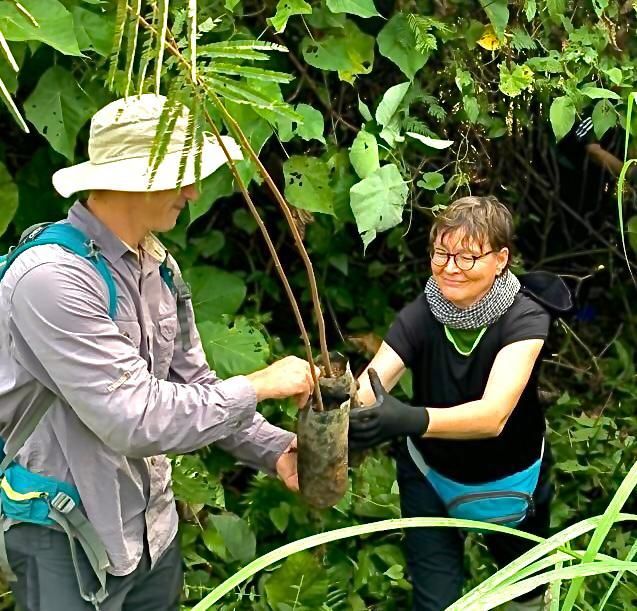
SWAG assists the Malaysian Conservation Collective (MyCC) to recruit volunteers from Singapore to participate in citizen conservation through Trek for Tigers patrols at the Sungai Yu Ecological Corridor in peninsular Malaysia. These patrols benefit both the local communities and wildlife, and protect the Malayan tiger’s only access point from Malaysia’s Taman Negara National Park to the Main Range (Banjaran Titiwangsa).
SWAG spent the first seven months of 2025 expanding our conservation networks, connecting with TRAFFIC Southeast Asia, RIMAU and MyCC, and introducing them to our supporters. From August through December, we recruited 18 volunteers for 3 anti-poaching surveillance walks along trails needing protection. We look forward to increasing citizen patrols in 2026 and are targeting a similar amount of activity as in previous years.
2. Actions to raise money for protecting wildcat habitats
SWAG contributed over SG$43,000 for tiger conservation and protection work in Malaysia in 2025. We donated SG$30,000 to TRAFFIC Southeast Asia to support law enforcement and the successful prosecution of wildlife crime in Malaysia under the Protecting Wildcats from Trade & Trafficking (PACT) programme; and SG$12,000 to RIMAU to support a wildlife ranger patrolling the Korbu Forest Complex. We also donated SG$1,000 to the Small Wild Cat Conservation Foundation to construct new enclosures for two wildcats in India.
3. Actions to study leopard cats in Singapore
Together with the National Parks Board (NParks), SWAG started on a study of leopard cat presence at Changi Coast in August 2025. This camera trap survey is ongoing, and we hope to provide an update in April 2026. The survey uses 18 camera traps at nine locations along the coast to try to determine the number of leopard cats and their habits, in order to form potential strategies for ensuring their long-term survival. A kind donor covered the cost of the cameras.
4. Actions to educate the public in Singapore to protect Southeast Asia’s biodiversity
- Held lectures on the Iberian lynx, Singapore’s last remaining wildcat - the leopard cat, and tiger conservation in Malaysia.
- Led over 200 people on Leopard Cat QUEST@Ubin night walks in search of the leopard cat.
- Organised outreach activities through information booths at Ubin Day, Festival of Biodiversity and Earth in Focus Singapore Nature Film Festival, storytelling at public libraries, and speaking at schools and organisations in Singapore.
- Conducted media interviews to raise awareness of endangered wildlife, particularly leopard cats and Malayan tigers.
- Partnered with RIMAU and The Tigers’ Forest project (by Drawing for the Planet and Born Free Foundation) to run three tiger education and drawing workshops for children in Singapore and Korbu, Malaysia.
- Engaged in outreach via social media platforms, including:
- The SWAGGER newsletter – 953 subscribers (+70 from 2024)
- Facebook – 1,600+ followers
- Instagram – 3,250 followers (+451 from 2024)
- LinkedIn – 207 followers (+35 from 2024)
- SWAGCAT.ORG – thousands of unique visitors weekly
5. Actions to eliminate illegal wildlife trafficking
- Monitored and advocated alongside local nature organisations for greater protection of wildlife and stronger penalties against violations of wildlife laws. We gratefully note marked improvement in this area borne out in actual seizures of illegal shipments transiting via Singapore.
- Stepped up to raise funds in support of the PACT programme.
- Raised awareness of illegal wildlife trade issues through frequent and regular posts on SWAG’s social media and newsletter.
(II) Climate Action
Climate science indicates rising global temperatures must be limited to 1.5°C to avoid the most significant impact of climate change. As a responsible organisation, SWAG measures our carbon emissions to allow for control and reduction as needed. This calculation work is done by Tim Foote (sustainability expert and active SWAG volunteer). SWAG reviews these measurements periodically, and we discuss how to improve our work so that emissions are minimised.
Overall Environmental Impact
SWAG is graded as a Climate Positive Plus organisation - our activities go beyond achieving net-zero carbon emissions to create an environmental benefit by removing additional CO2 from the atmosphere “plus” the additional carbon-capture level is above 25% of annual emissions.
Emissions
In 2025, our emissions were largely associated with MyCC Trek for Tigers and organisation/support activities in the Korbu Forest Reserve area. The emissions for all Scope 1, 2 and 3 activities were calculated at just over 6,026 kilograms. This is higher than in previous years due to the number of flights to Malaysia. On the plus side, SWAG sequestered a total of 7,834 kilograms of carbon from the continuing growth of trees planted by SWAG volunteers from 2020 to 2025.
Offsetting
Planting trees is the primary activity SWAG undertakes to offset emissions. Tree-planting is done by SWAG volunteers in Malaysia’s Sungei Yu Ecological Corridor and in cooperation with the Singapore National Parks Board’s One Million Trees Project. In 2025, SWAG planted 75 trees in Malaysia.
Operational Reduction Takes Willpower
As a 100-percent volunteer-run organisation, SWAG operates out of private residences with no headquarter emissions!
We do not manufacture any goods ourselves. Whenever possible, we sell fundraising items that are manufactured in an environmentally-friendly manner, and we account for the emissions produced in the items’ production. Occasionally, delivery of our goods is provided by Singapore Post, which delivers more and more using an electric-vehicle fleet.
Knowing that citizen action anti-poaching surveillance trips (eg. MyCC’s Trek for Tigers) require transportation to the Sungei Yu Ecological Corridor in Malaysia, SWAG leaders decided in early 2022 to use only ground transportation from Singapore. This substantially reduced the carbon footprint of such activities. With recent structural impediments to competitive ground transport options from Singapore into Malaysia, the logistics of travelling deep into Malaysia is becoming more complex. 2026 plans may have to include more air transport. However, volunteers willing to take the train (which we strongly encourage) will help offset carbon emissions incurred by other means of transport.
SWAG works to “operationalise green” in our procurement and operational processes. Learn more about this approach in Tim Foote’s article
“Dreams to Reality – Operations Builds a Green Future”.